Want to know how brands connect with influencers and promote their products online? Tomoson makes this process easier by bringing businesses and content creators together. It helps brands reach new audiences through social media posts, product reviews, and engaging content. Businesses can find creators who match their products and marketing goals. Influencers also get opportunities to work with brands and earn rewards by sharing their experiences. This makes the platform useful for both businesses and content creators.
Understanding How Does Tomoson Work? is easier when you look at its simple campaign process. Brands create campaigns and explain what they need. Influencers browse available opportunities and apply to join. Brands review applications and choose suitable creators. Once selected, influencers create content and share it with their followers. Both sides can manage their activities and review campaign results. Let’s look at how the platform works and what makes it useful.
Introduction
Influencer marketing lets businesses borrow trust. Instead of shouting through ads, brands partner with bloggers, product reviewers, and social media influencers. Those content creators share honest opinions with an audience that already listens. That’s where Tomoson enters the picture. If you’re asking how does Tomoson work, the short answer is simple. This influencer marketing platform connects brands with creators through product review campaigns and sponsored posts.
Tomoson marketing covers influencer discovery, product promotions, sponsored content, and campaign management. Brands find suitable creators. Influencers find brand collaboration offers. However, features and account rules change over time, so you’ll want to verify current details.
This guide explains what is Tomoson, how it works for brands and influencers, and what it costs. You’ll also learn its limits, safety checks, and alternatives. By the end, you can decide whether this creator marketplace fits your marketing strategy.
What Is Tomoson?
So, what is Tomoson? It’s an influencer marketing platform where brands and creators meet. Brands post campaigns. Bloggers, product reviewers, and social media influencers apply. According to MarketingProfs, the company has operated since 2010. Its co-founder said it focuses on small businesses rather than Fortune 500 giants.
Picture a skincare brand launching a new moisturizer. Instead of buying ads, the team offers free products to beauty creators. Those creators test the item and share honest product reviews with their followers. A kitchenware brand could do the same with food bloggers who film product demonstrations.
Tomoson influencer marketing works differently from traditional advertising. Creators speak to their own target audience on their own channels. Followers often trust those recommendations. Trust and audience engagement still vary from creator to creator.
For a Tomoson business owner, the draw is organization. The platform helps with finding partners, setting campaign requirements, and tracking content deliverables. Small businesses, established brands, and new creators can all explore promotional partnerships there. Just confirm which services run today.
How Does Tomoson Work Step by Step?
Here’s how does Tomoson work from start to finish. Brands offer campaigns. Creators apply. Both sides complete the agreed tasks. The details shift by campaign and by current platform features, so treat this as a general map. The seven steps below follow one campaign from signup to results.
Read More:PlayBattleSquare.com Minecraft: Is It Safe to Join? 2026
Step 1 — Create a Brand or Influencer Profile
Everything starts with account registration. Brands build a brand profile with product details, business information, and campaign goals. Influencers build an influencer profile showing their niche, content channels, audience data, and sample work. Tomoson’s influencer FAQ says an updated social profile helps with brand matching. Accurate details help both sides judge fit.
Step 2 — Create or Browse Campaigns
A brand writes the campaign brief. It names the product, the target audience, the content required, the deadline, and the compensation. Influencers then browse open campaigns. They look for products that match their interests and followers. A clear brief prevents confusion later. An older Inflow review shows the setup form also asked for ship dates and a product verification time.
Step 3 — Apply for Campaigns or Select Influencers
Creators submit campaign applications for offers that fit their experience. Brands then handle influencer selection. They weigh content quality, content relevance, audience engagement, and follower count. Practical Ecommerce notes that brands can sort creators by price, reach, and website traffic. Brands also set their own campaign eligibility rules.
Step 4 — Receive Products or Agree on Compensation
After approval, the creator checks the terms. Some deals include free products or discounted products. Others offer paid collaborations or affiliate commissions. Product shipping and campaign deadlines should be crystal clear before anyone accepts. Per the influencer FAQ, most products arrive at no charge while some carry deep discounts. Creators use them for product testing only, and SaaS Odds reports that selling a review item can get an account removed.
Step 5 — Create and Publish Content
The creator tests the product and starts content creation. That may mean a blog review, product demonstrations, or social media posts. The content should be original and reflect an honest experience. Content publishing happens once everyone agrees on the plan. Creators should add a material connection disclosure when they receive items free. The FTC sets those rules in the U.S.
Step 6 — Submit Proof and Complete the Campaign
Next, the creator submits proof. That usually means working links or screenshots of the live post. The brand checks that the work meets the brief. If something’s missing, it follows up. Some review sites also describe ratings after completion. Keep copies of messages and shipping details in case a dispute appears.
Step 7 — Review Performance and Results
Finally, brands study campaign performance. They look at engagement metrics, website traffic, sales conversions, and content quality. Those results show whether the collaboration met its goals. They also show whether a second partnership makes sense. Tomoson includes statistics and reporting on every plan, per SaaS Odds. Many reviewers still call them basic.
How Does Tomoson Work for Brands?
Tomoson for brands means organized influencer outreach. You don’t email every blogger one by one. Instead, you post a campaign, review applicants, and manage brand partnerships from one dashboard. Small teams without a marketing department benefit most.
Start with a goal. Maybe you want brand awareness, product awareness, lead generation, or sales. Each goal needs a different approach. A traffic campaign needs tracking links. An awareness campaign cares more about audience reach and content relevance.
Next, write a clear brief covering the product, target audience, deliverables, timeline, and marketing budget. Then choose creators whose content matches your brand. After product samples arrive and the work goes live, review the results.
Remember that influencer marketing takes planning. A big follower count doesn’t guarantee sales. A smaller, relevant creator often wins. Count the platform subscription, product costs, shipping fees, and creator compensation in your budget.
How Does Tomoson Work for Influencers?
Tomoson for influencers centers on finding product promotions and brand collaboration offers. Bloggers, reviewers, and social media creators browse open campaigns. Registration is free, according to the official FAQ. Still, check eligibility rules before you join.
Begin with a sharp influencer profile. Explain your niche, your content style, and your audience. A food blogger might pitch kitchen tools or pantry staples. Relevant samples help brands see what you offer.
When you apply, read the requirements closely. A free product isn’t paid work. Deadlines, posting rules, and content deliverables differ by campaign. Confirm whether you must publish a review or just test the item.
Professional communication matters too. Finish tasks on time. Share working links. Tell the brand quickly if a problem appears. Honest opinions and clear disclosures build your influencer reputation. That reputation helps you land better deals, whether you use Tomoson or another service.
What Are the Main Features of Tomoson?
Tomoson features support influencer campaigns from start to finish. Campaign management sits at the center. Brands describe an offer, state their needs, and review creators who show interest. That beats scattered email threads.
Influencer discovery is the second pillar. The platform offers a search tool that filters creators by reach, price, and traffic. Profiles and eligibility rules help brands compare partners. Still, check engagement and content quality yourself instead of trusting follower count alone.
Other tools add value. Gary Fox notes that you can add multiple accounts to one profile. A Slashdot listing also describes a content tool with feeds, hashtags, and scheduled posts. Statistics and report exports come with every plan.
Don’t expect enterprise analytics, though. Reviewers mention no advanced automation or AI. Detailed conversion tracking or audience research may need outside tools. Every plan includes the same features. Higher tiers simply raise your limits.
Does Tomoson Offer Free Products or Paid Campaigns?
Tomoson free products form the heart of the model. The influencer FAQ says most products ship at no charge. Some carry a steep discount. Each campaign explains how the product arrives.
Free items suit creators who want relevant gear. Yet a free product doesn’t equal income. Tomoson paid campaigns and paid collaborations are a separate deal, so confirm fees before work begins. Some campaigns also use affiliate marketing, where creators earn commissions on qualifying sales. Check each offer instead of assuming.
Both sides need the full picture. Brands budget for products, shipping, and any agreed creator pay. Creators weigh the hours spent on testing and content creation.
Honesty matters most. Brands shouldn’t demand praise. Creators should disclose free or discounted items. The FAQ says creators don’t have to review every approved product. Yet honest product reviews, good or bad, are the whole point.
How Much Does Tomoson Cost?
Tomoson pricing depends on your role. Influencers join free. Brands pay a monthly subscription fee after a free trial. SaaS Odds lists five plans: Basic at $49, Starter at $99, Business at $199, Agency at $399, and Scale at $599. A 21-day free trial starts at the Starter tier.
Plans differ by volume, not features. Higher tiers allow more active campaigns, monthly hires, and team seats. Business, at $199, is the most popular. That Tomoson business model keeps pricing simple.
Total influencer marketing costs run higher than the subscription. Add product samples, shipping fees, and creator payments. Tomoson’s own brand FAQ says so, as SaaS Odds quotes.
Prices change. Check Tomoson’s pricing page before paying. Skip old screenshots.
What Are the Benefits of Using Tomoson?
One big benefit is speed. Finding creators alone takes weeks. On this creator marketplace, bloggers and product reviewers already wait for offers. That shortcut helps newcomers to digital marketing.
Another perk is real-life content. A tutorial or detailed demonstration answers questions that ads can’t. Brands may also collect user-generated content (UGC) for later use. Just agree on content usage rights first.
Pricing is friendly too. Influencers pay nothing. Brands pay far less than on enterprise tools. Tomoson’s help center also says review posts often link back to your site, which may support SEO.
Creators gain as well. Campaigns build portfolios, experience, and professional relationships. Still, results depend on the match. A relevant creator, a useful product, and clear expectations beat sheer campaign volume. Treat Tomoson as a tool, not a growth guarantee.
What Are the Limitations of Tomoson?
Tomoson simplifies some work but not all. Creator fit comes first. An influencer with a huge audience may know nothing about your product. Followers then ignore the post, and audience engagement stays low.
Management takes effort too. Brands still prepare product information, ship samples, answer questions, and review content. Influencers spend hours on product testing and content creation. Several campaigns at once can overwhelm a small team.
Reviewers also name a dated interface, marketplace-only discovery, basic analytics, and occasional trouble linking social accounts. Some brands report fake followers on low-quality profiles. How does Tomoson work around that? It doesn’t fully. You vet creators yourself.
Platform availability matters, too. Features, pricing, and registration rules can change. Older guides may describe tools that no longer exist. And no platform guarantees viral posts or sales.
Is Tomoson Legitimate and Safe to Use?
Is Tomoson legitimate? Yes. A SaaS Odds review of its terms and FAQs concluded the platform is legit. It runs a real website with a privacy policy, payment conditions, and campaign policies. Still, a real company doesn’t guarantee every campaign is trustworthy.
Satisfaction varies. Some third-party sites report low ratings and slow support. Treat those reports as signals, not verdicts. Verify before you commit.
Start at the official site. Confirm account registration works. Read the terms and privacy policy. Be wary of anyone asking for passwords, bank logins, or upfront payments for a free product.
Brands should verify creator profiles and agree on deliverables, deadlines, and content permissions. Influencers should confirm what each campaign requires. Keep records and use the platform’s messaging when possible. Transparency protects everyone. Disclose free products and payments, give honest feedback, and never promise favorable reviews.
How Can Brands Measure Tomoson Campaign Results?
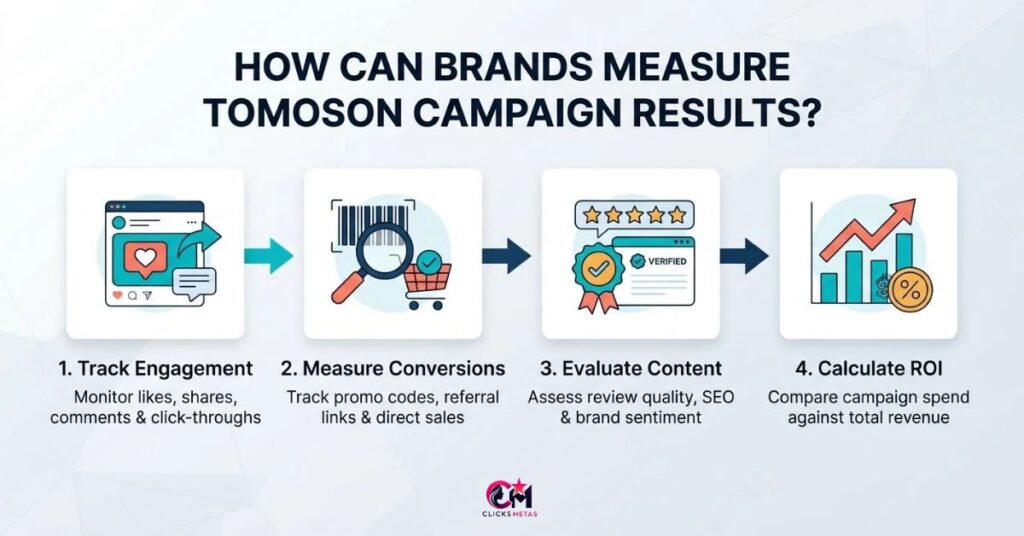
Brands need clear numbers. The right metrics depend on your goal. Awareness campaigns track audience reach and engagement metrics. Sales campaigns track clicks and purchases.
For website traffic, give each creator tracking links with UTM parameters. Unique discount codes tie sales to a specific partner. Website analytics then show whether visitors browsed, signed up, or bought. That’s your conversion tracking.
Next, calculate return on investment (ROI). Compare campaign results with total costs, including products, shipping, the platform subscription, and creator pay. Attribution isn’t perfect since shoppers often see content several times first.
Review content quality and comments too. They reveal how well creators explained the product. Tomoson’s built-in statistics help with performance tracking. Verify them before launch. If they fall short, add outside marketing analytics.
Tips for Getting Better Results With Tomoson
Good planning lifts results. Set one clear objective first. Awareness, traffic, and sales each need a different play.
Next, judge relevance, not follower count alone. Check recent posts, comments, and audience interests. A small creator in your niche often beats a giant outsider.
Write a detailed campaign brief. Cover the product, expected content, deadlines, compensation, and any limits. Settle content usage rights before publication, especially if you’ll reuse videos in ads.
Creators should accept only what they can finish on time. Brands should communicate clearly and leave room for shipping. Add disclosures to every sponsored post. Finally, start small. Test two or three partnerships and record the results. Then refine your next round before spending more.
Is Tomoson Still Available in 2026?
Yes, Tomoson appears active. Mid-2026 sources still list plans and prices, including a July 2026 SaaS Odds pricing page. Tomoson’s own brand and influencer FAQs remain online too. Still, a live page doesn’t prove every feature works.
If you want to use it, visit the official site. Check whether account registration opens, whether you can reach account features, and whether live campaigns appear. Brands should confirm subscription details before entering payment information. Influencers should confirm that suitable offers exist.
Mind publication dates on reviews. Older articles describe how things worked years ago. Even new third-party guides need checking against official pages. If you can’t reach the features you need, contact support or try another option.
What Are the Alternatives to Tomoson?
Several influencer marketing alternatives exist. The best one depends on your budget, campaign size, social media networks, and reporting needs.
Direct outreach is the simplest. You study creators, then pitch them yourself. You control who you pick. It costs time, though.
Other creator marketplaces compete on price. Enterprise tools like Upfluence, GRIN, and Aspire often start near $2,000 monthly on annual contracts, SaaS Odds reports. Affiliate networks pay creators only for qualifying sales. Marketing agencies manage everything at a higher cost.
Compare total price, search tools, analytics, payment arrangements, and content rights. The best alternative isn’t always the priciest. It’s the one that fits your practical needs.
Self-Service Influencer Marketplace vs. Full-Service Agency
With a self-service marketplace like Tomoson, you do the work. You search creators, approve them, ship products, and track results. You save money but spend time.
A full-service agency handles those jobs. It finds creators, writes briefs, negotiates, and reports. That convenience costs more. A founder with five spare hours may thrive on Tomoson. A company launching in ten markets likely needs agency muscle.
The Dual Identity of Tomoson.com in 2026
Tomoson.com wears two hats. It runs the marketplace. It also hosts many blog-style review posts on the same domain. Several read like generic SEO content. Some contradict each other. One post says Tomoson charges no agency fees. Another says it charges brands on top of campaign spend.
That mix confuses readers. So separate the layers. Trust the official pricing page, FAQs, and terms. Treat blog posts as commentary. Check each page’s type, its date, and whether outside sources agree.
Product Fulfillment, the 21-Day Verification Clock, and Escrow
Fulfillment means getting the product to the creator. Brands ship it. Practical Ecommerce says shipping can run inside the platform. Timing rules matter next. The older Inflow review showed a product verification time of three weeks after receipt. SaaS Odds describes a claim window of 40 to 55 days after shipping. The 21-day free trial is a separate clock.
Escrow is murkier. Some sources say funds sit in escrow. Others say built-in escrow is minimal. Before shipping, read the campaign page, confirm payment terms, and save tracking numbers.
Breakdown of Monthly Brand Plans and the 21-Day Free Trial
Five monthly plans exist, per SaaS Odds. Basic costs $49 for one active campaign and 25 hires. Starter costs $99 for ten campaigns and 100 hires. Business costs $199 for 30 campaigns and 300 hires. Agency costs $399 for 100 campaigns and 1,000 hires. Scale costs $599 for 100 campaigns and 3,500 hires.
Business is the popular pick at about $2,388 yearly. The free trial lasts 21 days and begins at Starter. Each brand gets one trial with up to ten campaigns. Opening a second account can trigger suspension.
Evaluating the $6.50 Per $1 Spent Return Claim
Tomoson’s best-known claim says brands earn $6.50 for every $1 spent. Shopify repeats it and adds that the top 13% earn $20 or more. That sounds fantastic. Yet it comes from a survey, not an audit.
MarketingProfs covered one Tomoson survey of only 125 online marketers. Small samples and self-reported answers limit what you can conclude. CustomerThink calls the claim unrealistic and risky to promise. Use it as a headline, not a forecast. Track your own ROI instead.
Throwaway Blogs, Fake Followers, and Off-Page SEO Risks
Not every creator is genuine. Older Inflow comments describe throwaway blogs built to collect free products. Commenters also alleged fake followers. Those are opinions, not audits.
SEO adds a twist. Tomoson’s help center says reviewers often link back to your site. Weak blogs create weak links. Check blog age, real traffic, and comment quality. Skip spammy sites. When products were free, ask creators to mark links as sponsored or nofollow.
Public 5-Star Rating Inflation and Outdated Policies
Glowing numbers deserve suspicion. Self-reported stars and testimonials can run high. Independent sites paint a mixed picture. Some summaries cite ratings near 1.5 out of 5 on Sitejabber, though those come from secondary reviews. Verify them yourself.
Stale details cause trouble too. Some pages still repeat the $6.50 claim. Blog posts disagree about fees and escrow. Read several independent reviews, check dates, and screenshot current terms before you commit.
Practical Vetting Checklist Before You Spend a Dollar
Run this check before spending. Open the official pricing and FAQ pages. Start the free trial before you pay. Verify each influencer’s accounts. Check engagement and comment quality. Ask for past work samples. Confirm payment terms in writing. Set tracking links and discount codes. Follow FTC disclosure rules. Launch one small campaign first. Save every message. It feels like work. It costs less than a failed campaign.
Frequently Asked Questions
Can Beginners Use Tomoson Without Previous Influencer-Marketing Experience?
Yes, if registration is open and you meet a campaign’s requirements. Tomoson is self-serve. Start with the free trial or a free creator account, pick one simple campaign, and track it with a discount code.
Do Influencers Need a Large Following to Apply?
No. Brands set their own rules. Some want big numbers while others want engaged niche readers. Check each campaign’s eligibility. Real engagement and relevant content often matter more than raw follower count.
Can a Brand Require an Influencer to Give a Positive Review?
No. The influencer FAQ says products exist for honest, unbiased testing. Brands can set deliverables. They can’t buy praise. U.S. rules also expect honest endorsements, so check the FTC’s guidance.
Can Businesses Reuse Content Created Through Tomoson?
It depends on the agreement. State reuse plans, platforms, and time limits in the brief. Get permission in writing before you run a creator’s video as an ad.
What Should Users Do If a Tomoson Campaign Is Unavailable?
First, refresh the page and check its status. The campaign may have ended or hit its hiring limit. Message the brand, check the help center, or contact support. Screenshot everything, then apply to similar campaigns or try direct outreach.
Conclusion
Understanding how does Tomoson work helps brands and creators decide whether its campaign model fits their goals. So, what is Tomoson in practice? It’s an influencer marketing platform that connects businesses with creators, organizes product promotions, and manages content tasks. Brands reach relevant audiences. Creators find products that match their interests.
Still, success takes more than a good match. Clear expectations, honest content, fair compensation, and solid performance tracking all matter. Before joining, confirm Tomoson’s current availability, pricing, and campaign terms on its official website.

